
Type B RCD Brands Worth Considering for Reliable Protection
2026-10-05
When it comes to safeguarding modern electrical systems against residual currents, Type B RCDs are non-negotiable—especially in installations with variable frequency drives or EV charging. But not all brands deliver the same level of dependability. If you're weighing your options, ETEK has been earning quiet respect among engineers who refuse to compromise on protection. Here are the Type B RCD brands truly worth your attention.
ABB Type B RCDs That Hold Up When Loads Get Unpredictable
Modern electrical systems rarely behave the way textbooks predict. Inverters, variable speed drives, and EV chargers inject a messy cocktail of smooth DC residual currents, high-frequency harmonics, and transient spikes that can confuse ordinary residual current devices. Many RCDs either trip for no apparent reason or, far worse, fail to respond when a genuine fault occurs. ABB's Type B RCDs are built to read this chaotic signature accurately, separating harmless noise from dangerous leakage without flinching.
What sets these devices apart is their ability to monitor both AC and pulsating DC residual currents up to 100 kHz, while also detecting smooth DC faults that Type A or F units simply cannot see. The internal sensing circuitry uses a continuous self-testing mechanism that verifies the tripping path every few seconds, so the protection remains intact even when the load profile shifts violently from one operating point to another. This means fewer nuisance trips during motor startups or solar inverter switching, and no blind spots when a DC fault develops on the line side of a drive.
Field experience shows that unpredictable loads are no longer the exception, but the rule in industrial and commercial installations. ABB Type B RCDs hold their calibration and tripping threshold steady across a wide temperature range and under heavy electromagnetic interference. Installers and panel builders choose them not just for compliance with evolving standards, but because they reduce downtime and troubleshooting hours. When the load refuses to follow a clean sine wave, these RCDs remain the one component you don't have to second-guess.
Schneider Electric’s Compact Type B Units for Cramped Boards
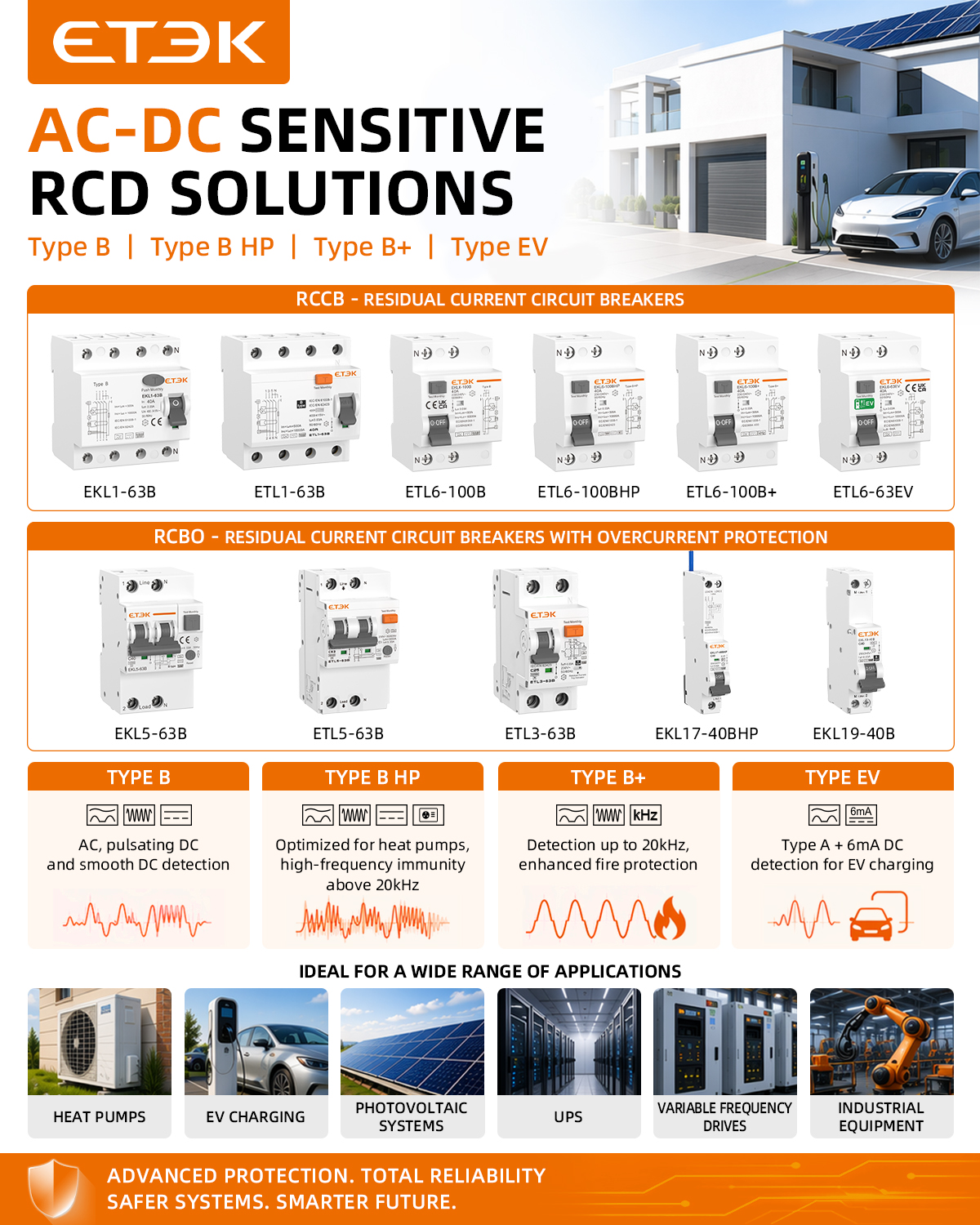
Finding space for a Type B residual current device inside an already crowded distribution board is often a trial. Standard units occupy a row of DIN rail that many older panels simply don’t have, pushing installers toward creative but less reliable workarounds. Schneider Electric’s compact Type B units take a different route, cutting the physical width without trimming the protection envelope. The result is a device that slips into cramped enclosures where a conventional four-module or wider Type B would never fit.
What sets these units apart isn’t just a smaller faceplate. The internal layout has been reworked so that sensitive DC detection circuitry and the mechanical trip mechanism share space more efficiently. That means you get the same response to smooth DC residual currents, tripping thresholds for EV charging and variable speed drives, and the same push-to-test simplicity, all in a housing that leaves adjacent ways free for miniature circuit breakers.
On site, the payoff shows up quickly. There’s less need to reposition busbars, splice cables, or swap a small enclosure for a larger one mid-installation. The saved rail space can go toward future circuits instead of being swallowed by a single protective device. For retrofits and high-density boards where every module counts, that often makes the difference between a straightforward upgrade and a full panel replacement.
Siemens Type B Protection for DC Leakage in Motor Drives
Modern variable-frequency drives introduce a spectrum of leakage currents that conventional residual current devices often fail to interpret correctly. Direct current components, in particular, can saturate standard AC-sensitive cores and render protection blind exactly when it is needed most. Siemens Type B protection addresses this blind spot by continuously monitoring both alternating and pulsating direct fault currents, ensuring that even smooth DC leakage is detected before it escalates into insulation breakdown or fire risk.
The sensing principle behind this protection relies on a combination of magnetic modulator technology and precision signal evaluation. Unlike Type A or F devices, which assume an alternating fault signature, the Type B core remains responsive to unidirectional current flow. This matters in motor drives because rectifier stages and regenerative braking can push DC offset into the ground path during normal operation. The protective device learns to distinguish these operational residuals from true insulation faults, reducing nuisance tripping while maintaining a fast response to genuine leakage events.
Field experience shows that drives with long motor cables, high switching frequencies, or integrated EMC filters benefit most from Type B supervision. By detecting DC leakage early, maintenance teams can schedule repairs before a ground fault disables the entire production line. The result is not just code compliance, but a measurable reduction in unplanned downtime and a safer operating environment for both personnel and connected equipment.
Eaton’s Type B RCDs with Sensible Tripping Thresholds
Type B residual current devices are essential wherever the load can generate smooth DC or mixed-frequency earth leakage, such as variable speed drives, EV charging points, and photovoltaic inverters. Eaton's approach to tripping thresholds is particularly practical because it acknowledges the continuous background leakage these systems often produce. Rather than forcing a one-size-fits-all level that leads to constant nuisance tripping, Eaton designs thresholds that remain fully protective while respecting the natural behaviour of modern power electronics.
The real advantage of a sensible threshold becomes clear during commissioning and daily operation. Equipment with EMC filters and long cable runs can easily leak several milliamps to earth without any fault being present. If the RCD threshold is set too aggressively, the installation suffers repeated downtime and bypass attempts. Eaton's Type B RCDs use carefully selected trip levels and, where relevant, adjustable settings so that faults are isolated decisively while harmless leakage does not interrupt production.
This balance matters most in mixed-use buildings and industrial facilities where protecting people and keeping processes running are equally important. By choosing Eaton Type B protection with sensible tripping thresholds, engineers avoid both under-protection and over-sensitivity, which is a more nuanced approach than simply meeting the minimum standard.
Doepke Type B RCDs Focused on Smooth DC Fault Detection
Most residual current devices handle AC or pulsed DC leakage without much trouble, but smooth DC faults present a different challenge. Doepke's Type B RCDs take this on directly, incorporating a dedicated detection circuit that remains sensitive to continuous direct currents. Rather than relying on transient spikes or waveform irregularities, these units monitor the actual magnitude of smooth DC residual current, which makes them suitable for installations where such faults can occur unnoticed.
The technology behind this involves a second core and fluxgate sensor arrangement, letting the device respond to DC components while still tracking AC leakage. This dual-path approach means the RCD does not compromise tripping accuracy for either current type. In practice, that matters for equipment like electric vehicle charging stations, three-phase rectifiers, or photovoltaic inverters, where a smooth DC ground fault might otherwise bypass conventional protection entirely.
Beyond simply detecting the fault, Doepke has tuned the trip threshold to balance safety with nuisance-tripping avoidance. The result is a device that acts quickly when a genuine smooth DC leak appears but remains stable under normal operating conditions with minor electronic noise. That kind of dependable response reduces unnecessary downtime and gives maintenance teams confidence that the protection is actually watching for the right signals.
Legrand Type B RCDs That Simplify EV Charger Installations
Installing an EV charger often brings a familiar headache: standard AC residual current protection doesn't catch the DC fault currents that modern electric vehicles can leak back into the circuit. Legrand's Type B RCDs address this directly, detecting both AC and smooth DC residual currents so you don't need to stack separate protection modules or oversize upstream breakers just to pass inspection.
What makes the Legrand range practical is the built-in flexibility for real-world installations. Many models come in compact widths that slot into existing consumer units without forcing a panel upgrade, and the wiring diagrams are genuinely simple—line, neutral, and a sense coil that monitors all live conductors. That matters when you're working in a cramped garage or retrofitting an older home where every DIN rail slot counts.
For electricians tired of troubleshooting nuisance tripping on EV circuits, the Legrand Type B units hold their threshold even when the vehicle's onboard charger creates transient DC offsets during startup or battery preconditioning. This means fewer callbacks, cleaner test results, and a single device that satisfies both the installer's need for speed and the customer's need for a safe, future-ready charging point.
FAQ
A Type B unit responds to AC residual currents, pulsating DC, and smooth DC faults. Type A stops at pulsating DC, so it can miss the smooth DC leakage that variable speed drives, EV chargers, and some PV inverters produce. If your installation has any of those, Type B is the only way to guarantee tripping across the full fault spectrum.
Doepke and Bender tend to lead in specialist circles because RCDs are their core business, not just one product line among hundreds. ABB, Siemens, Schneider Electric, Eaton, Hager, and Legrand also make dependable Type B units with wide availability and good local support. If you need something for a niche control panel, Doepke's DFS series or Bender's RCMB series are often specified.
Yes, in most modern installations. EV chargers can produce smooth DC residual currents during faults, and a Type A RCD won't reliably detect those. Many EV supply equipment manuals now require Type B or an equivalent combination of Type A plus a DC monitoring device. If you skip Type B, you risk a protection blind spot exactly where a cable gets damaged or a charger develops an insulation fault.
Look beyond the price tag. Check the rated residual operating current, the number of poles, whether it's suitable for 50 Hz and 60 Hz systems, and the maximum operating temperature. Also consider how easy it is to get replacement units or technical support in your region. A slightly more expensive unit from a brand with local stock and a proven test record often saves downtime later.
Not exactly. While all genuine Type B devices are designed to trip on smooth DC, the threshold and response time can vary slightly by manufacturer and model. Some are tuned for industrial environments with higher leakage backgrounds, others are more suited to residential EV circuits. Always check the datasheet for the rated residual operating current and any notes about frequency response.
One common issue is placing a Type B RCD downstream of a Type A or AC unit and assuming double protection. Another is mismatching the neutral conductor or failing to test both AC and DC tripping paths during commissioning. Always use the manufacturer's test procedure, and don't rely solely on the test button—it may only verify the AC portion of the detection circuit.
Usually yes, but check the physical width and the torque requirements first. Type B units are often wider than Type A equivalents, so a crowded board might need a small reconfiguration. Also verify that the busbar system matches the terminal positions. Brands like Hager and Schneider offer Type B RCBOs and RCCBs that fit their standard modular ranges, which helps when retrofitting.
It depends on the inverter. Many modern transformerless PV inverters can inject smooth DC residual currents under fault conditions, so a Type B RCD is increasingly recommended. For a small residential solar setup, the price difference is modest compared to the cost of the inverter and panels, and it closes a serious protection gap. If your inverter manual specifies Type B, skipping it creates a code compliance issue in many regions.
Conclusion
When alternating current starts behaving like direct current—think variable speed drives, solar inverters, or EV chargers—ordinary residual current devices can become dangerously blind. That's where Type B RCDs come in, and a handful of manufacturers have learned to address the messy realities of modern electrical loads. ABB's lineup, for instance, refuses to flinch under unpredictable load conditions; their units keep tripping accuracy intact even when waveforms get choppy. For panels where space is at a premium, Schneider Electric offers compact Type B modules that don't sacrifice performance just to fit into a tight board. Siemens takes aim at a specific pain point: DC leakage from motor drives. Their protection reacts quickly to the sort of residual current that would confuse a standard AC-only device, making them a sensible choice for industrial setups.
Eaton takes a more measured stance, designing Type B RCDs with tripping thresholds that avoid nuisance trips without compromising safety—a balance that matters in facilities where downtime is costly. Doepke's focus remains on smooth DC fault detection, with electronics that catch leakage before it becomes a hazard while steering clear of false alarms. Then there's Legrand, whose Type B units genuinely simplify EV charger installations. Rather than forcing electricians to juggle separate components, Legrand builds in the necessary DC protection, cutting installation time and potential wiring errors. None of these brands is perfect for every site, but each has carved out a reason to be on your shortlist. If unpredictable loads, tight boards, motor drives, or EV charging are on your project list, the right Type B RCD from one of these names is worth a closer look.
Contact Us
Contact Person: Andy
Email: [email protected]
Tel/WhatsApp: +86 13356133008
Website: https://www.etek-china.com/
